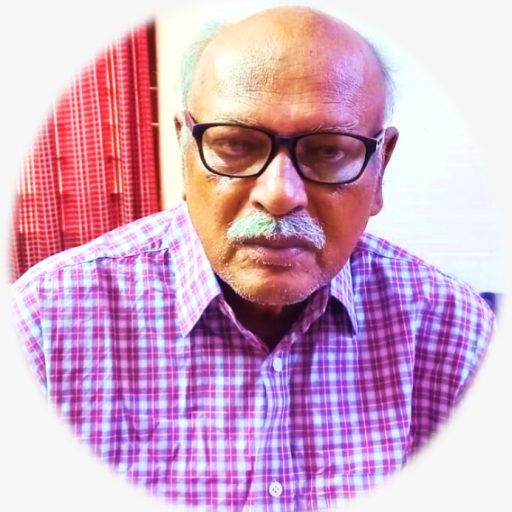
Believer in Communism, Dedicated to Social Revolution – Comrade Bimal Biswas
Childhood:
Comrade Bimal Biswas, a staunch believer in communism and devoted to social revolution, was born on July 12, 1946, in the historic village named Gobra, under Narail subdivision of Jessore district in British India. His father, Hajarilal Biswas, was a hereditary landowner, with the family’s income primarily coming from leasing farmland and fish farming in leased local water bodies. Bimal Biswas was the eldest of five brothers and two sisters. During his childhood, he was nurtured under the guardianship and affectionate care of his widowed paternal aunt. Her love and guidance played a significant role in shaping his sensitive intellect and thoughtful mindset.
Education:
The primary education for Bimal Biswas was begun directly from class three at Bargati Primary School. The following year, he enrolled in class four at Khalishakhali Government Primary School. When a primary school was later established in his native village, Gobra, he transferred there as a student of class five. Subsequently, he admitted in class six at Gobra Parbati Vidyapithfounded in 1923.
From class six to his Secondary School Certificate Examinations, Bimal Biswas was a bright student and a favorite among many teachers. Consistently ranking between first and third place in exams, along with his active participation in sports and theater, he earned a distinguished reputation among his peers. He became a well-liked and respected figure among general students.
However, this recognition also brought challenges. A few members of the communal and elite class grew resentful towards him, leading to a tragic experience in his life. Due to communal conflicts, an attempt was made to expel him from school. Although sympathetic teachers intervened and prevented his expulsion, he was subjected to financial penalties.
As a result, he lost several scholarships he had been receiving, including the scholarship awarded in the eighth grade, the Scheduled Caste stipend, and the school’s merit-based scholarship. This financial setback marked a difficult phase in his early academic journey.
His school life experiences made him aware of wealth-based and community-based aristocracy and ignited in him the spirit to fight against it. From an early age, he had a deep aversion to the authoritarian behavior of landlords and village elites, as well as the communal and casteist attitudes of some upper-caste Hindus. Despite being born into a Hindu family, by the sixth grade, he had formed close friendships and played alongside children from the Muslim community, the Namasudra-Rajbanshi (Fishermen), and the Pramanik (Barber) communities.
Political Involvement:
His participation in school dramas made him popular, but beyond that, it fostered a sense of equality and friendship across religious, caste, community, and gender lines. One of the key reasons for his widespread acceptance and popularity among both Hindu and Muslim communities was this inclusive outlook. Later, this very perspective led to his lifelong involvement in the communist movement.
His initiation into political movements began in 1962 when he was a student of class nine, through his participation in the student movement that emerged to demand students’ rightful claims against the iron-fisted rule of Ayub Khan. By organizing students from Gobra Parbati Vidyapith, Singiyasholpur High School, and Agdia High School and leading them in protests, he embarked on his political journey—one that continues to this day.
Until at least 1963, students had little opportunity for idleness, as the school fostered a disciplined and engaging learning environment. This well-rounded education allowed Bimal Biswas to develop social skills beyond academics, particularly in sports, debate, public speaking, and acting, nurturing his leadership abilities.
From 1962 to the mass uprising of 1969, his active involvement in student movements shaped his ability to lead revolutionary student politics in college. This, in turn, laid the foundation for his transformation into a full-time activist in the revolutionary movement for societal change.
Bimal Biswas was one of the key figures in establishing a strong and unyielding organization of the East Pakistan Students’ Union at Narail Victoria College. Through his continuous involvement in student politics, he emerged as an elected leader representing the general students.
In the academic year 1966-67, he was elected as the General Secretary (GS) of the Narail Victoria College Student Union. The following year, in 1967-68, he was elected as the Vice President (VP) of the same student union with an overwhelming majority of votes from the general students.
While he enjoyed immense popularity among general students in student politics, Bimal Biswas also had to endure the hostility of reactionary political forces and the oppression of the Pakistani government. He faced personal attacks, being labeled as an “Indian agent” and a “fisherman’s son,” among other slurs. Additionally, he was imprisoned three times during his time in student politics.
Bimal Biswas passed his Higher Secondary Certificate (HSC) in the science group with a second division scholarship. He had completed all preparations to enroll at Ahsanullah Engineering College in Dhaka. However, following the party’s directive, he remained in Narail for the sake of local political interests. This decision ultimately shaped his future political career.
Later, in 1968, he completed his Bachelor of Arts (BA) degree. He enrolled at Sundarban Law College in Khulna, but during this period, he became a full-time party activist. Due to an arrest warrant against him and party directives, he could not take his law exams. Consciously, he chose to dedicate himself as a full-time party worker instead of pursuing a professional career.
In the Liberation War of 1971, Bimal Biswas played a glorious role. Armed resistance was organized against the Pakistani military junta despite the absence of central party directives. In the greater Jessore district, attacks were launched on the Shalikha, Mohammadpur, and Lohagara police stations. Weapons and ammunition were seized from the occupying forces.
Bimal Biswas served as one of the principal commanders of the armed forces led by the EPCP (ML) party in the greater Jessore region. In fact, since March 1970, he had been in hiding due to false charges filed against him by the Pakistani government. His underground life continued until 1974. During this period, he not only engaged in intra-party struggles against the party’s flawed policies but also found himself compelled to fight against the Rakkhi Bahini (the paramilitary force of Bangladesh).
On May 13, 1974, Bimal Biswas was arrested by the Rakkhi Bahini from the village of Mandia in Egarokhan. The paramilitary forces subjected him to brutal torture—piercing his fingers and toenails with needles and date thorns, inflicting wounds and rubbing salt into them, forcing soda water into his nose, and placing him inside a sugarcane crusher to crush his bones and flesh from head to toe. He was held in their infamous oxygen-deprived torture rooms, where he was pushed to the brink of death. This took place during the era of parliamentary military rule, and he was held at the headquarters of the Narail and Jessore military forces.
During this time, several army officers, including Captain Habibur (Laksam), made sincere efforts to save him from torture. Many influential figures also intervened on his behalf, including the Deputy Commissioner of Jessore, the then-Principal of Victoria College Moazzem Hossain, Vice-Principal Haripada Bose, Professor of Philosophy Golam Mostafa, Leninist party leader Comrade Amal Sen, and Halima Karim (wife of Awami League leader Advocate Ali Karim, through Mizanur Rahman Chowdhury). They all tried their best to keep him alive.
After enduring over a month of severe physical and mental torture by the Rakkhi Bahini, he was finally transferred from the army headquarters to police custody in the first week of 1974. He was officially arrested under the Special Powers Act and sent to Jessore Jail. From there, he was moved through various prisons, including Mymensingh, Dhaka, Faridpur, and Barisal, suffering continued mistreatment. Eventually, on November 20, 1979, he was released on a High Court writ petition.
From 1980 to 2020, Bimal Biswas dedicated himself to uniting the fragmented groups of Pekingists, bringing together eight factions. He also played a key role in uniting the associated farmer, worker, and student organizations. Five agricultural organizations were merged to form the National Farmers’ Association, where he served as the founding General Secretary for many years.
Over his political career, he held leadership positions in various parties—first in the Revolutionary Communist League, later in the Communist League, and then in the Workers’ Party of Bangladesh, where he served as General Secretary for a total of 17 years. Throughout his political life, he remained a Politburo member of different parties for 28 years.
For nearly 40 years, Bimal Biswas led revolutionary movements by integrating national democratic struggles with class struggle politics. He actively participated in joint movements against the autocratic Ershad government, including the 5-party, 7-party, and 15-party alliances. In 1991, he contested the parliamentary election from the Narail-2 constituency.
He was also a key leader in the National Coordination Committee for the trial of war criminals. In 1994, he served as the coordinator of the Left Democratic Alliance, which was formed with eight leftist parties, for seven terms. Later, he was the coordinator of the 11-party coalition for 11 terms.
Since the formation of the movement to protect oil, gas, electricity, and ports in 1998, he actively participated on behalf of the Workers’ Party until 2020. Throughout his activism, he faced gunfire, attacks by hired goons, and police repression numerous times.
Throughout his life, he faced significant repression, including years of imprisonment and time spent in hiding. After his release in 1979, he worked to unite various communist groups, helping form several political organizations that eventually contributed to the Workers Party of Bangladesh.
On December 28, 2021, he resigned from the party, primarily due to differences over political strategy. His disagreements with the party grew after the Workers’ Party chose to contest elections under the ‘boat’ symbol (Awami League’s electoral symbol).
Upon resigning, he declared that despite leaving the party, he would dedicate himself to ideological and revolutionary theoretical political writing to advance the communist movement. He believes that rather than engaging in intra-party struggles against incorrect political strategies, focusing on fundamental theoretical work for Bangladesh’s revolutionary struggle would be more effective in uniting divided activists and advancing revolutionary politics.
Drawing from his 64 years of political experience and deep understanding of Marxist theory, over the past five years, Bimal Biswas has authored 10 books individually, co-authored two others and many more articles for future generations. He has also co-authored two analytical and political books with Comrade Muzammel Haque Tara and Comrade Azizur Rahman Asad. His writings and books are being made available on websites for the benefit of future generations, historians, and researchers.
Although there may be differences in interpretation, he has always relied on documented evidence and historical records as the basis of his writings. He has clearly stated that both domestic and international archives would validate his information. Coming from grassroots politics to national leadership, he faced many limitations and challenges.
Readers are encouraged to learn about Comrade Bimal Biswas through his writings and those of other leaders. If this brief introduction published on the website proves useful, it will give some fulfillment to his lifelong efforts.
He believed that he was born for human civilization and nature. Which he have written this realization of mine in the first volume of the book ‘Ja Dekhechi Ja Korechi (যা দেখেছি যা করেছি – What I have seen and done)’. That is why he donated his body after death to Dhaka Medical College Hospital on November 22, 2021.
On May 4, 1980, Bimal Biswas married a revolutionary political activist and school teacher Gouri Bala Roy was the head master of Metali Bidda Pit.His only son Srijan Biswas Souvik, Lecture at Otish Dipankar University, passed away from this world forever, losing the battle for life on January 22, 2020. On January 28, 2025, at 10:30 am, his wife Gouri Bala Roy passed away from this world forever, losing the battle for life. Just as Bimal Biswas has lost his fellow soldier and wife, Gouri Bala Roy.
After the premature death of only dearest son and beloved wife, Bimal Biswas has been living and writing with mourning grief in caring of his only daughter Dr. Ishita Biswas, an Associate Professor and medicine specialist at National Medical College, and his son-in-law, Chayan Singh, a former cardiology and medicine specialist at PG Hospital. His companion in his later years is his 11-year-old grandson, Sannidhya Singh.
Despite the negative impact on his health due to his time in prison, the torture by the paramilitary forces, and the irregularities of fulfilling party duties, Bimal Biswas remains active in thought and writing. With the help of digital communication technology, he continues to work toward his vision of political transformation in Bangladesh.
He believes that the strategic mistakes in Bangladesh’s communist movement stem from fundamental theoretical misconceptions. These include misunderstandings regarding social imperialism, expansionism, the Three-Worlds Theory, and the Sino-Soviet split. He asserts that without resolving these theoretical confusions, Bangladesh’s social revolution cannot be accomplished.
Known for his principled and uncompromising stance, Bimal Biswas remained committed to socialism even after global setbacks to the movement. It is important to note that ideological and political differences with the Workers Party began to emerge around 2010. Despite making repeated attempts to withdraw his membership, the situation continued to deteriorate. Eventually, the conflict escalated, and he formally submitted his resignation on April 22, 2000. However, instead of accepting his resignation, the party expelled Bimal Biswas through an unjust and improper process. To justify this expulsion, the party even provided explanations to CPI(ML) and other international organizations, claiming that such action was necessary to preserve the party. Interestingly, within a month of his expulsion, the president of the Workers Party resumed close communication with him. Although he maintained contact with the reconstituted Workers Party for about four months, he ultimately decided to withdraw completely.
To this end, he actively exchanges ideological and political views with various socialist and communist parties and individuals in Bangladesh. He aspires to cultivate young Marxist activists in the Egarokhan region and is committed to playing a unified role with like-minded individuals until his last breath.